

Marioff invests in Kerava factory to support growth and sustainability
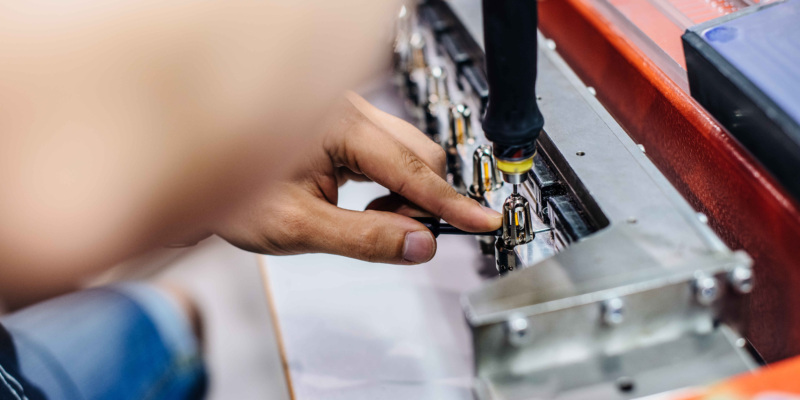
Marioff continues to invest in its main manufacturing site to support growing global demand for its fire protection systems. Located in Kerava, Finland, just a short distance from the company’s birthplace, the factory plays a central role in Marioff’s global operations, as all key HI-FOG system components are produced there.
In 2025, we produced nearly 300,000 sprinklers, 12,000 valves, and over 1,000 different pump units. This was done by our team of about 110 professionals.
As demand for HI-FOG® systems grows worldwide, the company continues to strengthen its production through targeted investments in machinery, production layout, and testing capabilities. The investments strengthen productivity, support sustainability goals, and ensure Marioff can continue delivering high-quality fire protection systems to customers worldwide. According to Marioff’s Director, Operations and EH&S, Anne Kauppila, the expansion reflects the company’s long-term strategy to continuously refine and develop its production capabilities.
“Even replacing a single machine with modern technology can significantly increase capacity and reduce risks related to breakdowns,” Kauppila explains. “But machinery is only one part of the equation. Improving efficiency also involves hiring skilled staff, refining production planning, and developing flexible shift models.” To support future growth, the factory has also strengthened collaboration with existing suppliers and identified new partners to expand machining outsourcing. In total, investments in factory improvements will amount to approximately $3.8 million in 2025 and $3.7 million in 2026.
“These new investments allow us to address development needs that have accumulated over time. We are grateful that our owner has confidence in Marioff and in our growth prospects.”
Anne Kauppila, Operations DirectorWe have increased our production volume by around 30%. This allows us to shorten delivery times and respond more flexibly to customer needs.
Increased production capacity benefits customers
The investments directly strengthen Marioff’s ability to serve customers worldwide.
Production capacity has already increased significantly, enabling the factory to respond more efficiently to growing demand.
“We have increased our production volume by around 30%. This allows us to shorten delivery times and respond more flexibly to customer needs. At the same time, modern machinery helps us maintain the extremely high-quality standards our systems require,” Kauppila says.
More precise manufacturing also helps reduce material waste, improving both efficiency and sustainability.
2025: New CNC machines and improved production flow
In 2025, the Kerava factory added five new CNC turning machines.
Four machines were installed in the sprinkler production line, increasing annual production capacity by approximately 12,000 hours.
The fifth machine was installed on the valve machining line and includes automation in the form of an industrial robot that handles loading, unloading, and compressed air cleaning.
Alongside the machinery upgrades, the factory also optimized the layouts of the sprinkler and pump assembly lines to improve production flow.
“We refined the layout to improve throughput. This is especially important as demand continues to grow,” Kauppila says.
Modern technology supports sustainability goals
The new equipment also contributes to Marioff’s environmental targets. Modern machines consume less energy while delivering higher performance. In some cases, a single new machine can replace multiple older units. “One modern machine can replace two machines that we have been using to produce hi-mix low-volume parts,” Kauppila explains.
Another major step forward will take place in 2026, when the pump testing electric supply by the diesel generator will be replaced with an electrical transformer connected to the local main electric supply. “This is an important milestone in our sustainability journey and supports our goal of achieving carbon-neutral operations at the Kerava factory by 2030,” Kauppila says.
The factory has also significantly reduced its reliance on district heating. “Today, we only use it as a backup. Moving away from it completely is another step toward our carbon-neutral target.”
2026: Expanded testing and advanced machining
Further upgrades are planned for 2026. A new turning and milling center will replace an existing sprinkler body machine, while another turning center will be installed to produce hi-mix low-volume valves and other specialized components.
“The new machinery allows us to increase output while maintaining the consistency and precision our fire protection components require,” Kauppila explains.
The factory will also expand its testing facilities for electrical pumps and cylinder units.
“Testing is a critical step in our production process. By adding two new testing stations, we ensure our testing capacity grows in line with production.”
Strong teamwork behind the expansion
Implementing these upgrades has required close collaboration across the organization. Introducing new machinery, adapting layouts, and integrating new processes involved experts from multiple disciplines working together.
“It has been a significant effort for many teams,” Kauppila says. “Careful planning and strong cooperation ensured everything was implemented according to schedule and budget. I’m extremely proud of the work our team has done.”

Learn how our commitment to sustainability guides the way we operate today—and how we’re shaping a more responsible tomorrow.
Sustainability at Marioff